
The right judgment is not always the just result - a judgment often fails to account for the time and expense invested to obtain it.
But sometimes, the grinding gears of litigation can be used to achieve some justice. In Leeman v. Adams Extract & Spice Co. (Cal. Ct. App. - May 21, 2015), plaintiff settled a Prop. 65 (toxic chemicals warning) case - cases typically driven by a cottage-industry of "sue and settle" lawyers. The settlement here was for a typically small amount of civil penalties, and a typically much larger amount of fees at $72,500, with hourly rates up to $895. Another victory for cottage-industry lawyers, it would seem.
But not so fast, says Judge Goldsmith. He cuts the requested fee award in half. Plaintiffs move, first ex parte, then on a noticed motion, to modify this award to the stipulated amount. Judge Goldsmith denies both attempts, without explanation.
Predictably, the Court of Appeal reverses, telling Judge Goldsmith that he can't just whack the fees for no reason, and that he also can't approve the settlement but reduce the fees, since the entire thing stands or falls as a whole.
So in the end, the cottage-industry lawyers get their fees, to which they have a statutory right. But as professor Shaun Martin explains, it's Judge Goldsmith who gets the last laugh:
"I wonder if a part of him was thinking: "You bastards. You know full well this was a shakedown, and that the $72,500 fee award was excessive. You think I can't do anything about that. And you're largely right. I'm not going to keep a crappy case in my court (by disapproving the settlement) just to stop you from getting your fees. But you know what I can do? I can make it hard for you. I can slash your fee award. Once. Twice. Thrice. Make you file three motions. Make you prosecute an appeal. Make you wait a couple of years. And, yeah, you'll get your $72,500. But you'll at least have to work for it."
A recent opinion of the California Court of Appeal held a New York choice-of-law clause was ineffective to enforce a party's waiver of jury trial. In Rincon EV Realty LLC v. CP III Rincon Towers, Inc., New York-based parties negotiated a loan agreement with a New York choice-of-law clause, signed the agreement in New York, and disbursed the funds in New York, with the funds ultimately going to build apartments in San Francisco. In a lawsuit following a default of the loan, the California court nonetheless held that, although New York law generally allows jury-trial waivers, and although the parties expressly agreed to New York law, the waiver would violate a fundamental policy of California and thus was unenforceable.
Shareholder protections also are implicated by this ominous exception to choice-of-law enforceability. Under Nevada law, for example, judgment creditors may not obtain a turnover order against a shareholder of a Nevada corporation - the shares may not be seized, and the sole remedy is a charging order against future distributions. (Nev. Rev. Stats. 78.746.) Predicting a judgment creditor would seek to apply contrary California policy, TVA recently filed a complaint for declaratory relief in Nevada state court, seeking an order that Nevada's shareholder protections apply. To avoid the outcome and dismiss the suit, the judgment creditor was forced to promise, on the record, that it would not seek to overcome Nevada's shareholder protections.
As a result of TVA's Nevada lawsuit, when the creditor sought to enforce its judgment in California court, the creditor had to acknowledge that Nevada law applied.
Beware of depending unduly on a choice-of-law provision.
Irrevocable trusts are often used to protect assets from the reach of creditors, but courts have chipped away at their foundation. In U.S. v. Harris, No. 16-10152 (9th Cir. Apr. 20, 2017), the Ninth Circuit recently held that a beneficiary's right to receive discretionary distributions from an irrevocable trust constitutes "property" to which a government lien may attach.
In 1997, Michael Harris was convicted of eight federal criminal counts related to theft from an employee benefit plan, sentenced to 30 months in prison, and ordered to pay the government $646,000 in restitution. Harris is and was the beneficiary of two irrevocable, discretionary trusts established by his parents for support. Typically, creditors - such as the federal government, in this case - cannot seek recovery of assets held in an irrevocable trust; only revocable trusts can be attacked. But in 2015, the government sought a writ of continuing garnishment for any property - i.e., cash - distributed to Harris from the trusts. In other words; the government did not seek to compel the trustees to turn over the assets to the government; instead, it sought an order that, should any funds be distributed from the trusts in the future, said funds had to be paid directly by the trustees to the government.
The Ninth Circuit held that the government was entitled to garnish the future distributions. A federal restitution lien attaches to any "property" of a debtor, property being defined by "the breadth of the control the taxpayer could exercise over the property." (Id. at 4.) In California, the law grants a beneficiary such as Harris the absolute right to compel distributions from a trust "insofar as those distributions are necessary to fulfill the trusts' purposes." (Id. at 5.) Because "Harris has a right to receive distributions under California law, his interest in the discretionary trusts is not a mere expectation...it constitutes 'property'." (Id. at 6-7.)
The key here seems to be that California law permits the beneficiary to compel distributions. If the distributions were entirely discretionary - i.e., at the whim of the trustee - they likely wouldn't be considered "property" to which the lien could attach, as Harris - as the beneficiary - would have no control over them. But because he can exert some degree of control, the future distributions are subject to attachment.
While the opinion itself isn't groundbreaking, it's yet another example of "irrevocable" trusts nonetheless failing to provide sufficient asset protection.
With the recent publicity of Hulk Hogan's lawsuit against Gawker Media, and specifically the funding of the lawsuit by third-party Silicon Valley billionaire Peter Thiel, much attention has been drawn to the practice of "litigation funding."
The term refers to the practice in which an outside party funds all or part of a plaintiff's litigation in exchange for a portion of the recovered proceeds. The rise of the practice stems partially from the significant cost of litigation; faced with incurring hundreds of thousands of dollars in attorneys' fees - if not more - many plaintiffs are reluctant to commence a lawsuit, even a righteous one.
Enter a litigation funding firm. Essentially, rather than the attorney taking the case on a contingency basis, the third party funds the case on a similar basis. (At least, that's the basic conceptual model. Some larger litigation funding firms have extended their reach to other avenues, including purchasing judgments to pursue.)
As the application of the practice has grown, and as attorneys and clients have become more comfortable with litigation funding, the industry has boomed. One of the preeminent litigation funding firms, Burford Capital Ltd., recently announced that its profit after tax rose 75 percent from the prior year, and the firm committed $378 million to new investments (a yearly increase of 83 percent). If, as expected, the practice becomes even more commonplace, expect that growth to continue.
"It is often said that good fences make good neighbors. One might wonder whether there actually is such a correlation between good fences and good neighbors and, if so, whether causality runs in the opposite direction (i.e., maybe good neighbors build good fences). But it cannot be denied that a good fence accurately demarcating the boundary between the parties' real properties in this case could have avoided substantial expense and grief." (Seraji v. Demirjian, Case No. G048611 (4th Dist., Div. 3 July 17, 2014) (unpublished).)
A property owner in Laguna Beach sued a neighbor for encroaching on his undeveloped parcel. The owner prevailed on his trespass and ejectment claims, but the Court of Appeal reversed on the trespass claim because the action was filed after the three-year statute of limitation. The ejectment claim was timely under the longer five-year statute.
(In fact, an ejectment claim never expires unless the encroacher can establish superior title via adverse possession or a prescriptive easement. (Harrison v. Welch (2004) 116 Cal.App.4th 1084.))
The owner also argued he was entitled to recover his attorneys' fees. Civil Code section 3334, a trespass and ejectment statute, provides: "The detriment caused by the wrongful occupation of real property . . . is deemed to include the value of the use of the property for the time of that wrongful occupation . . . and the costs, if any, of recovering the possession." Because attorney's fees is not specifically mentioned in the statute, the lower court properly refused to award them. (That v. Alders Maintenance Assn. (2012) 206 Cal.App.4th 1419, 1428.)
For more on damages under Civil Code section 3334, see our blog at californiatrespasslaw.com.
In a recent property-dispute opinion, the Second District in Shoen v. Zacarias came to the perfectly sensible decision that equity is not aroused by a trespasser's inconvenience in relocating $275 in lawn furniture. As is so often interesting (and frustrating) about the law is that reasonable minds can disagree. In fact, the trial court had ruled otherwise, and the sage Professor Shaun Martin agrees. At bottom, however, I think the trial court and the good professor lean on appeals to equity more than established legal rules. In the latter respect, the reviewing court got it right.
Professor Martin's blog fairly lays out the facts and legal doctrines. In short, the dispute was over a small flat patch on a steep slope between two neighbors' homes. One neighbor owned the flat patch, but the slope made it inaccessible. The other neighbor, oddly, happened to have stairs on her property reaching the patch. She used the stairs to put some tables and deck chairs, and proceeded to enjoy her neighbor's property. After a time, the owner decided she wanted to build a wall on her property and needed the patch back.
The trial court awarded the trespasser an equitable easement for 15 years upon payment of the patch's $5,000 value. The trial court concluded the balance of hardships tipped in favor of the trespasser, reasoning that the owner had enough land already and the trespasser would be out $275 and probably wouldn't like the owner's new wall. From the vantage of a brooding omnipresence in the sky, one can follow the basic logic. On the other hand, one can almost hear the owner muttering "what business is it of yours how much land I have or what I do with it?"
The Court of Appeal reversed, holding that the equitable principle requires more from the trespasser than merely establishing the hardships "tip" in her favor. Rather, they must "tip disproportionately," and even "greatly disproportionate[ly]," in the trespasser's favor. Moreover, because equitable easements effectively give the trespasser the right of eminent domain, courts must "resolve all doubts against their issuance." Merely depriving her stairs and patio furniture of their purpose did not rise to that standard.
After initially agreeing, Professor Martin ultimately sides with the trial court. He observes that the owner had no way to enjoy the patch as much as the trespasser did (though he ignores the owner's desire to use it for a wall), and so the trespasser was, in effect, making the highest and best use of it, a "socially optimal result."
To reach that conclusion, the professor argues that the trespasser's harm of $275 is greatly disproportionate to the owner's harm. That's because, the professor continues, the owner cannot use the patch, making it worth nothing. And because $275 - or any amount - is "infinitely greater" than zero, the trespasser's harm is greatly disproportionate.
But this approach, though clever, ignores three important facts. First, the trespasser's harm is not $275; it is zero. After all, she gets to keep the furniture. Second, even if the patch is worthless as a spot for the owner to retreat with a cup of chamomile, it is apparently quite suitable as a site for a wall or other conceivable uses. Children, for example, tend to enjoy scaling and barreling down hills and would not find the patch so inaccessible as an adult looking for a place to enjoy afternoon tea. Third, $275 is a trifling sum anyway, and the law disregards trifles. (Civ. Code § 3533.)
Were I mediating the case, I would probably urge the result adopted by the trial court and endorsed by the good professor. But courts are provided to enforce the rules as already established, not as we would like them to be. An old, cynical Italian saying goes, "The moment a law is passed, the way around it is found." There are enough people looking to find ways around the law without jurists and practitioners pitching in.
Pokemon Go-maker Niantec moved to dismiss the class action that alleges the wildly popular app causes droves of users to trespass on private property in order to find, buy, and play with in-game prizes. Niantec points the finger at its users, insisting the game maker is not responsible for what users do since it displays disclaimers telling them not to trespass.
But as we've written, trespass does not require knowledge of the plaintiff's ownership, or knowledge of the entry, as long as the trespass is foreseeable. "An entry may also be accomplished by setting in motion an agency which, when put in operation, extends its energy to the plaintiff's premises to its material injury." (Elton v. Anheuser-Busch Beverage Group, Inc. (1996) 50 Cal.App.4th 1301.) Thus, even a hacker's electronic signals have been held to be a trespass. (Thrifty-Tel, Inc. v. Bezenek (1996) 46 Cal.App.4th 1559, 1566, fn. 6.). "Trespass may be '"by personal intrusion of the wrongdoer or by his failure to leave; by throwing or placing something on the land; or by causing the entry of some other person . . . ."'" (Martin Marietta Corp. v. Insurance Co. of N.A. (1995) 40 Cal.App.4th 1113, 1132.)
The hearing is set for May 4.
You can find our articles on this story at our California Trespass Law site.
The high court recently published Park v. Trustees of the Cal. State Univ., reversing a split appellate-panel decision. The Court held plaintiff's retaliation claim could go forward and did not implicate protected conduct just because the trustees' decision involved protected communications.
Skimming the decision, I was eager to find a discussion of the Court of Appeal's crazy decision in Tuszynska v. Cunningham (2011) 199 Cal.App.4th 257. Tuszynska held that a victim's allegations of employment discrimination and retaliation "arose from" the employer's protected investigation and termination decision. That Fourth District opinion's rationale, however, was later discredited, rightly in our view, by the Third District in Nam v. Regents of the Univ. of Cal. (2016) 1 Cal.App.5th 1176. Applying precedent in the California Supreme Court opinion of Navellier v. Sletten (2002) 29 Cal.4th 82, Nam underscored that "'Quite to the contrary, the Supreme Court determined that the SLAPPer's, not the defendant's, intent was irrelevant." We thus do not ignore the defendant's alleged motive.'" (Nam, supra, 1 Cal.App.5th at p. 1189.)
In other words, the protected activity is the defense or alternative explanation for the alleged conduct - not what the lawsuit "arises from." Because of course a fraud defendant, for instance, cannot defeat a complaint by asserting he stole money to use it on "protected conduct." And of course that fraud defendant cannot defeat the complaint by asserting the plaintiff is only upset about the "protected conduct" his stolen money was used on. Misappropriation of funds "is not constitutionally protected." (Gaynor v. Bulen (2018) 19 Cal.App.5th 864, 869-870.)
My eagerness was repaid as Park decides this split against authority against Tuszynska:
"The Tuszynska court concluded that, for anti-SLAPP purposes, a discrimination suit alleging an attorney was denied case referrals because she was a woman was necessarily based on both the referral decisions -and, concomitantly, communications defendants made in connection with making those decisions. (Tuszynska, at p. 269.) To the extent Tuszynska v. Cunningham, supra, 199 Cal.App.4th 257 presupposes courts deciding anti-SLAPP motions cannot separate an entity's decisions from the communications that give rise to them, or that they give rise to, we disapprove it."
Despite best efforts to reduce expectations to a written contract, one can rarely estimate with much accuracy the creative ways a complaining party will claim he has been damaged by an alleged breach. The textbook case from the 19th century in Hadley v. Baxendale arose when a smith delivered a crankshaft too late, and the miller sued not only for the value of the crankshaft, but for all the lost profits caused by the delay - a tenfold increase!
These downstream injuries are called "consequential" damages, as opposed to the "direct" damages (e.g., the value of the crankshaft). The good news: these wild and wooly consequential damages may be limited by agreement.
California Civil Code § 3300 allows plaintiffs to recover both kinds of damages, providing for recovery in "the amount which will compensate the party aggrieved for all the detriment proximately caused thereby, or which, in the ordinary course of things, would be likely to result therefrom."
Direct damages naturally arise from the breach, such as the cost of a replacement crankshaft, or the cost of hiring a different contractor or professional. (See Brandon & Tibbs v. George Kervorkian Accountancy Corp. (1990) 226 Cal.App.442, 455-56.)
Consequential damages, on the other hand, do not flow immediately from the breach, but follow as some consequence of it, which might be unusual so long as they were reasonably contemplated by the parties, such as lost profits or a real-estate collapse.
While few California cases address the issue, Perini Corp. v. Greate Bay Hotel & Casino (N.J. 1992) 610 A.2d 364 remains a seminal consequential-damages case. When hotel construction fell behind, the hotelier sued the contractor for four-months of lost profits. The delay resulted only from a nonessential ornamental facade, and even though the contractor's take was only $600,000, it was held liable for a whopping $24 million.
The court held that liability was appropriate because the casino repeatedly told the contractor that time was of the essence and that delays would result in lost profits from the summer tourist season. Had the parties contemplated otherwise in their contract, the contractor would not have been liable for these downstream, consequential damages.
By expressly stating in the written agreement that the parties do not contemplate liability for consequential damages, parties can prevent being held liable for surprising and upsetting circumstances.

Aman is handing out leaflets in the train station, an old Soviet joke has it, when he is stopped by an officer. Examining the leaflets, the officer discovers they are just blank pieces of paper. "What is the meaning of this?" the officer asks. "What is there to write?" the man replies. "It's so obvious!"
The pleading practice of filing fully detailed leaflets in court has sometimes lurched toward the practice of the man in the train station. The federal "short and plain statement," and California's "ultimate fact" pleading, not only provide the barest of notice of what sort of mischief defendant is believed to have gotten up to, but also allow inconsistent allegations bordering on alternative realities, and amendments of charging allegations right up to, during, and - in a case of remand after appeal - even after judgment. Defendants less notorious than Stalin are likely to ask that grievances against them be made rather more obvious than liberal pleading norms allow them to be.
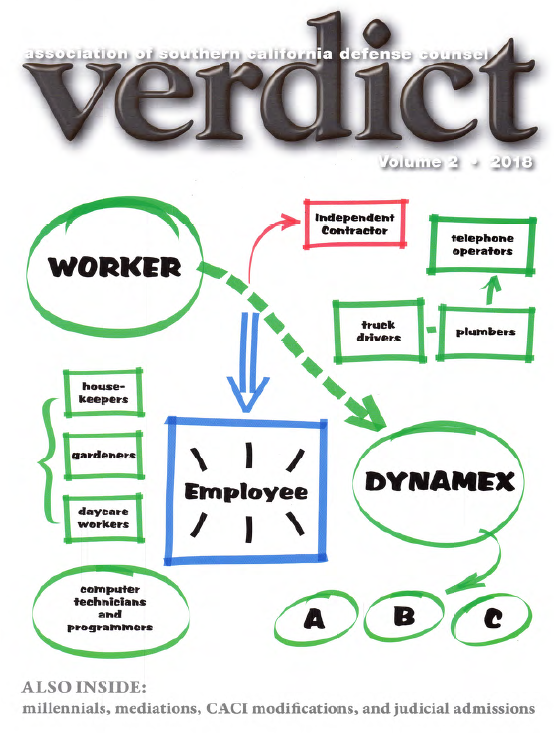
And when those grievances are stated plainly, they should, by all rights, be binding on the plaintiff as judicial admissions. Though they do not always recognize it, lawyers and judges rely on judicial admissions routinely. Every demurrer is based on judicial admissions after a fashion - i.e., that the well-pleaded factual allegations in the complaint be accepted as true as against the plaintiff, binding the plaintiff to their legal effect. (Serrano v. Priest (1971) 5 Ca1.3d 584, 591.) Under this standard, only the plaintiff, and not the defendant, is saddled with the effect of the fact in the complaint, which is why defendants rest easy invoking the statute oflimitations without fear of being accused of having admitted liability. (E.g., Uram v. Abex Corp. (1990) 217 Cal.App.3d 1425, 1433.) And of course defendants are not made "to playa risky game of roulette" by acceding to facts in a complaint "for summary judgment purposes" to expose plaintiff's legal theories as untenable. (Myers v. Trendwest Resorts, Inc. (2009) 178 Cal. App.4th 735, 746-748.)
Or take for example the judicial admissions in pleadings against defendants who settle out prior to trial. The remaining defendant at trial has good reason to point to those allegations in support of alternative causes of the injuries or contributing fault by the absent defendants. Those allegations, after all, earned plaintiff leverage against the settling defendants. Yet some judges seem reluctant to hold the plaintiff to the truth of their own allegations.
The source of this reluctance, in many cases, is the tension between judicial admissions, which are conclusive and binding, and pleading rules, which are pliable and, in some cases, optional. Where a judicial admission is based in the pleadings, its enforceability depends, by definition, on the durability of those pleadings. Under rules that allow plaintiffs to rewrite their complaints as if working from a blank leaflet, admissions rooted in the pleadings will be elusive. Employee defendants, for instance, may find themselves accused in a personal-injury complaint of acting in the "course and scope" of their employment (making their employer vicariously liable), then, when the same defendants invoke their employer's arbitration rights, newly accused of acting outside the course and scope, and then, finally - to suit plaintiff's substantive theory - back again to having acted within the course and scope. (See 24 Hour Fitness, Inc. v. Superior Court (1998) 66 Cal.App.4th 1199.)
On closer inspection, however, many such cases fall outside the judicial-admissions canon - the 24 Hour Fitness case, for example, did not directly discuss judicial admissions. No known cases criticize judicial admissions. But liberal pleading standards, taken to extremes, undermine the doctrine: allowing pleaders to keep their hand always at the plow makes for inhospitable soil for judicial admissions to take root.
OVERVIEW OF JUDICIAL ADMISSIONS
An "admission of fact in a pleading is a 'judicial admission.'" (Bucur v. Ahmad (2016) 244 Cal.App.4th 175, 187 (citing Valerio v. Andrew Youngquist Construction (2002) 103 Cal.App.4th 1264, 1271.) The rule applies equally to unverified pleadings (see Code Civ. Proc., §§ 420, 422.10; Womack v. Lovell (2015) 237 Cal. App.4th 772, 786), and attorneys' authority to file pleadings on behalf of their clients is a rebuttable presumption. (Evid. Code, §§ 1222 et seq.; Dolinar v. Pedone (1944) 63 Cal.App.2d 169, 176-177.) Once a party has pleaded facts "in support of a claim or defense, the opposing party may rely on the factual statements as judicial admissions." (Myers, supra, 178 Cal.App.4th at p. 746.)
The judicial admission is commonly a creature of pleading (Castillo v. Barrera (2007) 146 Cal.App.4th 1317, 1324-1326), though it also appears in the forms of stipulations (Morningred v. Golden State Co. (1961) 196 Cal.App.2d 130, 137) and requests for admission that have been admitted or deemed admitted. (Brigante v. Huang (1993) 20 Cal.App.4th 1569, 1578, disapproved on other grounds in Wilcox v. Birtwistle (1999) 21 Cal.4th 973, 983, fn. 12.)
Distinctive about its nature, then, is the judicial admission" is entirely different from an evidentiary admission. The judicial admission is not merely evidence of a fact; it is a conclusive concession of the truth of a matter which has the effect of removing it from the issues …. " (Troche v. Daley (1990) 217 Cal.App.3d 403, 409, quoting Walker v. Dorn (1966) 240 Cal.App.2d 118, 120; Heater v. Southwood Psychiatric Ctr. (1996) 42 Cal.App.4th 1068, 1079, fn. 10.)
A judicial admission, no mere flesh wound, cuts to the bone: a trial court "may not ignore a judicial admission in a pleading, but must conclusively deem it true as against the pleader." (Bucur, 244 Cal.App.4th at p. 187 (citing Thurman v. Bayshore Transit Management, Inc. (2012) 203 Cal.App.4th 1Jl2, Jl55).)
OVERVIEW OF PLEADING AMENDMENTS
For such reasons have courts historically insisted on good reason for amending pleadings. Honesty in pleading, at least, has been required since at least Justinian, whose code required parties to swear on the justice of their cause, and even expected lawyers to resign their case if they found it dishonest.
The California Supreme Court continues to take a dim view of situational pleading, holding that "'[a]s a general rule a party will not be allowed to file an amendment contradicting an admission made in his original pleadings" unless "upon very satisfactory evidence that the party has been deceived or misled, or that his pleading was put in under a clear mistake as to the facts.'''
(Brown v. Aguilar (1927) 202 Cal. 143, 149; Reichert v. General Ins. Co. (1968) 68 Cal.2d 822,836-837 [amended complaint properly dismissed where plaintiff gives no explanation for omitting prior allegations].
As a safeguard, superseded pleadings may be considered for the purpose of impeachment. (Meyer v. State Board o/Equalization (1954) 42 Cal.2d 376,385; Staples v. Hoejke (1987) 189 Cal.App.3d 1397, 1412 [error to refuse to admit unverified, dismissed crosscomplaint to impeach]; Cahill Brothers, Inc. v. Clementina Co. (1962) 208 Cal.App.2d 367, 383.) And pleadings from a prior action may be asserted either as direct or impeachment evidence. (Coward v. Clinton (1889) 79 Cal. 23, 29 [commenting, but not deciding, that prior pleadings also should be considered admissions]; Kamm v. Bank o/California (1887) 74 Cal. 191, 197-198. Accord Magnolia Square Homeowners Association v. Safeco Ins. Co. (1990) 221 Cal. App.3d 1049, 1061 [allegations in prior action are evidentiary in nature]; Fibreboard Paper Products Corp. v. East Bay Union o/Machinists (1964) 227 Cal.App.2d 675, 707; Nungaray v. Pleasant Valley Lima Bean Growers and Warehouse Assn. (1956) 142 Cal.App.2d 653, 667; Dolinar v. Pedone (1944) 63 Cal.App.2d 169, 176-177.)
BETWEEN A ROCK AND A SOFT PLACE: RELAXING THE RULES OF PLEADINGS UNDERMINES JUDICIAL ADMISSIONS
Though binding and irrevocable, a judicial admission is rooted in the pleadings, and rests on a shaky foundation when courts treat pleadings as pliable. One court has reasoned that a judicial admission "is not set in stone" because the trial judge" has discretion to relieve a party from the effects of a judicial admission by permitting amendment of a pleading." (Barsegian v. Kessler & Kessler (2013) 215 Cal.App.4th 446,452, fn. 2. See also Dang v. Smith (2010) 190 Cal.App.4th 646, 659, fn. 8.) Parties seeking to avoid a judicial admission, then, might simply - as though seeing themselves caught between a rock and a soft place - seek to amend their pleadings. "Occasionally he stumbled over the truth," Churchill once remarked of former Prime Minister Stanley Baldwin, "but he always picked himself up and hurried on as if nothing had happened."
The correct analysis is reflected in Valerio v. Andrew Youngquist Constr. (2002) 103 Cal. App.4th 1264, 1272, reversing a quantum meruit judgment on the grounds plaintiff judicially admitted the existence of a written contract when answering the crosscomplaint. The court noted that, though this judicial admission could have been excused had Valerio moved to amend his pleading, and that such motion "would have been granted" (id. at p. 1273), the pleadings otherwise stand: "While the result here is rigorous, the rule is clear and [defendant] is entitled to rely upon it. To hold otherwise would undermine well-settled rules of pleading relied upon to properly structure litigation." (!d. at pp. 1273-1274.)
Not only that, to allow a plaintiff to assert new factual theories virtually at will would replace Justinian with civil procedure according to Groucho Marx: Those are my allegations, and if you don't like them … well, I have others.
A CASE STUDY: THE SECOND AND FOURTH DISTRICTS DIVERGE ON WHETHER A PLAINTIFF'S ALLEGATIONS OF DEFENDANTS' AGENCY RELATIONSHIP ARE JUDICIAL ADMISSIONS SUPPORTING A MOTION TO COMPEL ARBITRATION
In 2012, the Fourth District, Division One considered judicial admissions in the context of a motion to compel arbitration. In Thomas v. Westlake (2012) 204 Cal. App.4th 605, plaintiff sued an investment firm and various brokers, advisors, and other defendants, who petitioned to compel arbitration. Plaintiff protested that none of the defendants save one was a signatory to the arbitration agreement and thus were not entitled to arbitrate. When defendants pointed out that plaintiff alleged in his complaint that defendants "acted as an agent of each other," plaintiff insisted that was "only a theory of tort liability" and not, presumably, anything plaintiff had expected anyone to take seriously.
Thomas rejected plaintiff's cynical view of his own pleadings: "Having alleged all defendants acted as agents of one another, [plaintiff] is bound by the legal consequences of his allegations." (Id. at p.614.) It "would be unfair to defendants to allow [plaintiff] to invoke agency principles when it is to his advantage to do so, but to disavow those same principles when it is not." (!d. at p. 615.)
Yet just one year later, however, the Second District, Division One ruled quite differently on a similar set of facts. In Barsegian, supra, 215 Cal.App.4th 446, plaintiff made similar allegations of defendants' agency relationships with one another. As in Thomas, certain defendants invoked the arbitration rights held by their codefendants - their "agents," in plaintiff's telling. The trial court denied the motion. Unlike in Thomas, however, this time the Court of Appeal affirmed.
Barsegian distinguished Thomas on the ground that Thomas "does not make clear whether the mutual agency of the defendants was conceded by all sides for all purposes," whereas the moving defendants in Barsegian explicitly did not concede the allegation that they were agents of each other. (Id., at p. 453.) Perhaps the reason why Thomas did not "make clear" whether defendants agreed with the agency allegations is because it shouldn't matter: a judicial admission bars "the party whose pleadings are used against him or her," not the party the pleadings are asserted against. (Id., at p. 451, citing Myers, supra, 178 Cal.AppAth at p. 746 (emphasis added).) Inverting this rule, the reader will recall, would "force defendants to playa risky game of roulette" when asserting a judicial admission against the pleader. (Myers, supra, 178 Cal.App.4th at p. 748.) But the gap between Thomas and Barsegian is indeed the space to watch: courts will likely enforce a judicial admission to bind a plaintiff to the legal effect of the pleadings (e.g., Uram, supra, 217 Cal.App.3d at p. 1433), but will not likely enforce a judicial admission merely to estop a plaintiff from correcting factual errors. (E.g., Dang v. Smith (2010) 190 Cal. AppAth 646, 659, fn. 8.)
A procedural motion such as a petition to compel arbitration makes for a harder case, which in Barsegian yielded questionable law. Distracted, perhaps, by the possibility of an inequitable result, Barsegian stated that a judicial admission is a "foctual allegation by one party that is admitted by the opposing party. The factual allegation is removed from the issues in the litigation because the parties agree as to its truth." (Id., at p. 452.) The court supplies the italics, but no citations. Instead, the court reasoned that a judicial admission is binding only "because the parties agree to its truth." (Id.) And thus a judicial admission in the Barsegian court means the fact "is effectively conceded by both sides."
As discussed above, however, the stipulation is but one of at least three species of judicial admission. Although Barsegian acknowledges that facts admitted in response to requests for admission are also judicial admissions, it fails to note that, like judicial admissions in pleadings, they are not stipulative in nature. But who knows? When Barsegian concludes, pedal down, throttle out, that "a judicial admission is therefore conclusive both as to the admitting party and as to that party's opponent" (id., italics in original), attorneys who have recently propounded RFAs might feel that last bit an unwelcome finger pointed in their direction: will the responses to my discovery prove "conclusive both as to the admitting party and to that party's opponent"?
If courts follow Barsegian rather than Thomas, factual allegations in a complaint would be binding only to the extent the defendant counter-admits them. The holding of Barsegian, if adopted, would fundamentally narrow and indeed redefine the judicial-admissions doctrine.
RE-ADMISSION: THE FOURTH DISTRICT'S 2012 OPINION SHOWS THE PATH TO ESTABLISHING JUDICIAL ADMISSIONS
The Fourth District's 2012 opinion in Thurman, supra, 203 Cal.AppAth 1112 offers a road map to establishing a judicial admission consistent with Thomas, and notwithstanding Barsegian. There, the operative verified complaint sought recovery for Labor Code meal- and rest-break violations. It alleged defendants had been providing meal periods from July 2003 onwards, yet the trial court nonetheless awarded the plaintiff recovery for missed meal periods after that date, finding the plaintiff not bound by the admission: the trial court felt it would "elevate pleading form over the facts" and "would give dignity to the 'gotcha' theory oflitigation." (Id., at p. 1154.)
ReverSing, the Court of Appeal noted the steps the defendants took to highlight that admission, and the steps plaintiff failed to take to relieve himself from it. (Id., at pp. 1156-1157.) The defendants worked overtime to enforce the admission, "clearly object[ing] before, during, and after trial, to the admission of evidence of missed meal periods after July 2003," and filing a motion in limine to prohibit introduction of such evidence. (Id.) And the plaintiff failed to amend the complaint despite indicating it would do so in its opposition to the motion in limine. (Id., at p. 1156.)
The Court of Appeal also noted that the defendants "prejudicially relied on [the] judicial admissions," as the defendants prepared a settlement offer under Code of Civil Procedure section 998, calculating the amount of the statutory offer in reliance on the admission that they had no liability for missed meal periods after July 2003, and that permitting the plaintiff to walk back his judicial admission could allow him to recover damages in excess of the offer. (!d., at p. 1157.) (Emphasis on prejudice, however, probably causes the judicial-admissions analysis to tread on judicial estoppel's turf. (See Pajaro Valley Water Management Agency v. Amrhein (2007) 150 Cal.App.4th 1364,1383-1384.))
In terms of establishing a judicial admission, the job description in Thurman involves long hours with few rest breaks: the admission in the complaint was clear and unequivocal; it was relevant to a material fact in the case; it was invoked as to the merits rather than in a procedural motion; and the complaint, seasoned through litigation, discovery, and trial, including objections and a motion in limine, was not susceptible to amendment without prejudicing the defendant.
But the Thurman factors are not all indispensable elements, and the judicial admissions canon merely requires a clear allegation in a pleading. Against healthy judicial concerns against elevating form over function, the judicial admission follows from the principle that a lawyer may not file a complaint absent grounds to believe the allegations are true. It is the pleader who engages in "sharp practice" in making factual allegations against the named defendants "unless, after a reasonable inquiry, the plaintiff actually believes that evidence has been or is likely to be found" to support the assertions; the actual-belief standard of pleading "requires more than a hunch, a speculative belief, or wishful thinking: it requires a well-founded belief. (Kojababian v. Genuine Home Loans, Inc. (2009) 174 Cal.AppAth 408, 421-22 [citing Supreme Court precedent].) If a lawyer files a complaint with factual allegations without the requisite actual belief in their truth, the lawyer can be sanctioned (Code Civ. Proc., § 128.7, subd. (c)) and is subject to other discipl inary action. (Pickering v. State Bar (1944) 24 Ca1.2d 141 (per curiam ); see Bus. & Prof.Code, § 6068, subd. (d).) Not every allegation, in other words, is a stick good enough to beat a defendant with.
Yet despite these fundamental rules of honest and reasoned pleading, some trial courts -like the one reversed in Thurmanmay feel that invoking the doctrine of judicial admissions would work a "gotcha" on plaintiff. Pity, as a proper application of the doctrine might inspire more discipline in pleading practice. For many litigants are not unlike Mark Twain when he observed he "could remember anything, whether it had happened or not." Give them enough liberties in pleading practice and they'll prove it.
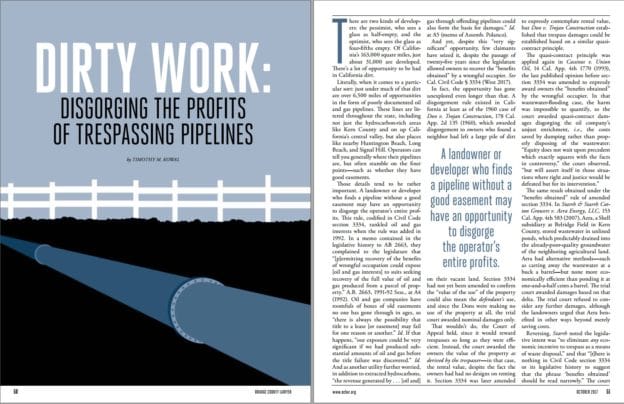
There are two kinds of developers: the pessimist, who sees a glass as half-empty, and the optimist, who sees the glass as four-fifths empty. Of California’s 163,000 square miles, just about 31,000 are developed. There’s a lot of opportunity to be had in California dirt.
Literally, when it comes to a particular sort: just under much of that dirt are over 6,500 miles of opportunities in the form of poorly documented oil and gas pipelines. These lines are littered throughout the state, including not just the hydrocarbon-rich areas like Kern County and on up California’s central valley, but also places like nearby Huntington Beach, Long Beach, and Signal Hill. Operators can tell you generally where their pipelines are, but often stumble on the finer points—such as whether they have good easements.
Those details tend to be rather important. A landowner or developer who finds a pipeline without a good easement may have an opportunity to disgorge the operator’s entire profits. This rule, codified in Civil Code section 3334, rankled oil and gas interests when the rule was added in 1992. In a memo contained in the legislative history to AB 2663, they complained to the legislature that “[p]ermitting recovery of the benefits of wrongful occupation could expose [oil and gas interests] to suits seeking recovery of the full value of oil and gas produced from a parcel of property.” A.B. 2663, 1991-92 Sess., at A4 (1992). Oil and gas companies have roomfuls of boxes of old easements no one has gone through in ages, so “there is always the possibility that title to a lease [or easement] may fail for one reason or another.” Id. If that happens, “our exposure could be very significant if we had produced substantial amounts of oil and gas before the title failure was discovered.” Id. And as another utility further worried, in addition to extracted hydrocarbons, “the revenue generated by . . . [oil and] gas through offending pipelines could also form the basis for damages.” Id. at A5 (memo of Assemb. Polanco).
And yet, despite this “very significant” opportunity, few claimants have seized it, despite the passage of twenty-five years since the legislature allowed owners to recover the “benefits obtained” by a wrongful occupier. See Cal. Civil Code § 3334 (West 2017).
A landowner or developer who finds a pipeline without a good easement may have an opportunity to disgorge the operator’s entire profits.
In fact, the opportunity has gone unexplored even longer than that. A disgorgement rule existed in California at least as of the 1960 case of Don v. Trojan Construction, 178 Cal. App. 2d 135 (1960), which awarded disgorgement to owners who found a neighbor had left a large pile of dirt on their vacant land. Section 3334 had not yet been amended to confirm the “value of the use” of the property could also mean the defendant’s use, and since the Dons were making no use of the property at all, the trial court awarded nominal damages only.
That wouldn’t do, the Court of Appeal held, since it would reward trespasses so long as they were efficient. Instead, the court awarded the owners the value of the property as derived by the trespasser—in that case, the rental value, despite the fact the owners had had no designs on renting it. Section 3334 was later amended to expressly contemplate rental value, but Don v. Trojan Construction established that trespass damages could be established based on a similar quasi-contract principle.
The quasi-contract principle was applied again in Cassinos v. Union Oil, 14 Cal. App. 4th 1770 (1993), the last published opinion before section 3334 was amended to expressly award owners the “benefits obtained” by the wrongful occupier. In that wastewater-flooding case, the harm was impossible to quantify, so the court awarded quasi-contract damages disgorging the oil company’s unjust enrichment, i.e., the costs saved by dumping rather than properly disposing of the wastewater:
“Equity does not wait upon precedent which exactly squares with the facts in controversy,” the court observed, “but will assert itself in those situations where right and justice would be defeated but for its intervention.”
The same result obtained under the “benefits obtained” rule of amended section 3334. In Starrh & Starrh Cotton Growers v. Aera Energy, LLC, 153 Cal. App. 4th 583 (2007), Aera, a Shell subsidiary at Belridge Field in Kern County, stored wastewater in unlined ponds, which predictably drained into the already-poor-quality groundwater of the neighboring agricultural land. Aera had alternative methods—such as carting away the wastewater at a buck a barrel—but none more economically efficient than ponding it at one-and-a-half cents a barrel. The trial court awarded damages based on that delta. The trial court refused to consider any further damages, although the landowners urged that Aera benefited in other ways beyond merely saving costs.
Reversing, Starrh noted the legislative intent was “to eliminate any economic incentive to trespass as a means of waste disposal,” and that “[t]here is nothing in Civil Code section 3334 or its legislative history to suggest that the phrase ‘benefits obtained’ should be read narrowly.” The court remanded to consider other potential benefits, provided “there is a direct link between the financial benefit and the trespass.” This appears to carry forward a similar quasi-contract analysis as Don v. Trojan Construction and Cassinos.
The only other case to award “benefits obtained” damages is Bailey v. Outdoor Media Group, 155 Cal. App. 4th 778 (2007), as readers will recognize from Dan Jacobsen’s article in the January 2015 issue of this magazine. See Dan Jacobsen, Not Your Parents’ Trespass Damages, Orange County Lawyer, Jan. 2015, at 28. Bailey is notable for expanding the disgorgement remedy twice: by applying it outside the toxic-pollution context, and by disgorging the occupier’s profits, not just the costs saved. In that case, a billboard operator continued running ads without a valid lease. The upshot of section 3334 is it puts the landowner in the “catbird seat,” and the occupier acts at its own peril:
A trespasser remains in possession of the property at its peril. . . . Stated bluntly, [the landowner] was in the catbird seat, and given his superior position, [the occupier] remained in possession of the property at peril of ultimately being held liable for damages measured under section 3334 by the benefits obtained by reason of its wrongful occupancy.
Bailey, 155 Cal. App. 4th at 791.
Bailey even left the door open for recovering gross profits in certain cases. And yet, there are no reports to date of landowners accepting the invitation.
The biggest missed opportunity recently might be the class action against the makers of Pokémon Go. The app earned a staggering 500 million downloads in 2016 by making certain landowners’ property part of its popular “pocket monster” game in which users look for virtual characters and destinations in real-world locations. A collaboration between game giant Nintendo and newcomer Niantic, the boundaries-no-object global scavenger hunt is estimated to have earned just under a billion dollars in revenue in 2016 alone, adding several billions to Nintendo’s market value. Under Civil Code section 3334 and Bailey, the property owners who found themselves virtually trampled underfoot could have sought disgorgement of Niantic and Nintendo’s profits from their wildly successful treasure hunt. Yet plaintiffs did not raise these California authorities in their pleadings, or apparently in opposing defendants’ motions to dismiss.
Solano County alfalfa farmers also likely missed a disgorgement opportunity when they found a gas pipeline under their fields in the early 2000s. The alfalfa croppers prevailed at trial, only to obtain a judgment for nominal damages, since the pipelines had not caused them any harm. The Court of Appeal reversed in Bello v. ABA Energy Corp., 121 Cal. App. 4th 301 (2004), holding the pipeline, operating under a county permit, was valid under the more modern, expansive scope of public rights-of-way. But prior to appeal, you can bet that a disgorgement judgment based on the statutory five-years’ worth of naturalgas profits would have improved the alfalfa concern’s ability to negotiate a favorable settlement.
But despite the pipeline industry’s admission of the likelihood of errant pipelines, there are oddly few cases bringing claims on them. One explanation is the energy companies were on the hyperbolic side in their earlier fulminations against the disgorgement rule, and there simply aren’t very many pipelines operating without good title. Then again, in 2014, a Bakersfield developer found four wild pipelines in a single parcel, and none of the operators would move their pipelines until the author’s firm filed a federal complaint and obtained a mandatory preliminary injunction. It seems still likely, then, that the opportunities are there but that landowners don’t know quite where to look, or how.
The looking, however, might be easier than you think, courtesy of, ironically enough, the energy industry. It starts with a toll-free call to 8-1-1. That’s the number to DigAlert, a nonprofit corporation created and funded by pipeline operators. See Gov. Code § 4216 et seq. (West 2017). DigAlert can notify the operators of any pipelines in a property where a project is planned: building expansions, housing additions, landscaping, retaining wall construction, repaving, etc. DigAlert previously required that the project be ready to break ground, but will now also respond during the planning phase. Simply mark the proposed project area and, once you obtain the locations of the pipelines, check them against a current title report. If there are pipelines without easements of record, demand that the operators either supply any other evidence of their right to operate on your property, or write a check for its benefits obtained pursuant to section 3334 by wrongfully occupying the property for the past five years.
A quarter-century has passed since oiland gas-pipeline operators bemoaned their substantial exposure for their stray pipelines. There’s still time to make their predictions come true.
Timothy M. Kowal is a civil litigator and appellate lawyer specializing in trespass, land use, and business law. He can be reached at tkowal@tvalaw.com.
This article first appeared in Orange County Lawyer, October 2017 (Vol. 59 No. 10), p. 50. The views expressed herein are those of the author. They do not necessarily represent the views of Orange County Lawyer magazine, the Orange County Bar Association, the Orange County Bar Association Charitable Fund, or their staffs, contributors, or advertisers. All legal and other issues must be independently researched.