
“CEB has published” Tim Kowal, “Something You Didn't Know About 998 Offers,” CEB (Apr. 30, 2021), available at http://bit.ly/3AbqAhI
Plaintiff can still recover post-offer fees even if Plaintiff does not beat the 998 offer, according to Regueiro v. FCA US, LLC (2d Dist., Div. 1 Nov. 19, 2020) Case No. B301772 (unpublished).
My original blog post is here: http://bit.ly/3WWidjS
Tim Kowal is an appellate specialist certified by the California State Bar Board of Legal Specialization. Tim helps trial attorneys and clients win their cases and avoid error on appeal. He co-hosts the Cal. Appellate Law Podcast at www.CALPodcast.com, and publishes a newsletter of appellate tips for trial attorneys at www.tvalaw.com/articles. Contact Tim at tkowal@tvalaw.com or (714) 641-1232.
Get a weekly digest of these articles delivered to your inbox by subscribing here: https://tvalaw.com/california-appellate-newsletter.
“CEB has published” Tim Kowal, “Making Sense of the California Supreme Court's Publication Rules,” CEB (May 21, 2021), available at http://bit.ly/3Emu0AC.
Attorneys are aware how important it is to confirm the precedential value of a recent published "smoking gun" decision on all fours with your case. One factor that can greatly disturb the citability of an appellate decision is whether the California Supreme Court has decided to review it. The Supreme Court recently amended rule 8.1115. Fortunately, the amendment is arguably rather sensible. In short, while Supreme Court review is pending, you can still cite your smoking gun case, and the trial court may follow it, even if another appellate court disagrees with it. Less fortunate is that, if your smoking-gun case was taken up for review on an issue completely separate from your smoking-gun issue, the case loses precedential effect on your smoking-gun issue, too, as collateral damage.
My original blog post is here: http://bit.ly/3EoVwxd
Tim Kowal is an appellate specialist certified by the California State Bar Board of Legal Specialization. Tim helps trial attorneys and clients win their cases and avoid error on appeal. He co-hosts the Cal. Appellate Law Podcast at www.CALPodcast.com, and publishes a newsletter of appellate tips for trial attorneys at www.tvalaw.com/articles. Contact Tim at tkowal@tvalaw.com or (714) 641-1232.
Get a weekly digest of these articles delivered to your inbox by subscribing here: https://tvalaw.com/california-appellate-newsletter.
When you have a legal emergency and you need the Court of Appeal to act right away, you need writ relief. But less than 10% of writ petitions are granted. So how do you get the court’s attention?
Justice David Thompson spent more time on his court’s writ panel over the last decade than anyone, and here is his advice:
You have to demonstrate why your case is writ-worthy in the first paragraph.
The first paragraph.
And the big thing you have to explain is: You are going to get a chance to appeal at the end of the case—why isn’t that enough? Why do you get to jump the line?
Also consider highlighting an interesting legal issue: some justices may be inclined to grant writ review to write on an issue they find interesting (though Justice Thompson does not endorse this school of thought).
Watch the clip here.
This is a clip from episode 54 of the California Appellate Law Podcast. The full episode is available here.
Tim Kowal helps trial attorneys and clients win their cases and avoid error on appeal. He co-hosts the Cal. Appellate Law Podcast at www.CALPodcast.com, and publishes a newsletter of appellate tips for trial attorneys at www.tvalaw.com/articles. His appellate practice covers all of California's appellate districts and throughout the Ninth Circuit, with appellate attorneys in offices in Orange County and Monterey County. Contact Tim at tkowal@tvalaw.com or (714) 641-1232.
CEB has published my article, “MSJ Evidence Rulings Are Discretionary, California Appellate Court Holds in Split of Authority,” about the recent published opinion in Doe v. Software One, Inc. (D4d3 Oct. 12, 2022 no. G060554) 2022 WL 6901145 holding that evidentiary rulings in connection with summary judgment are reviewed on appeal for abuse of discretion. The article is here.
The PDF article is here: Kowal_MSJEvidenceRulings
The opinion is interesting because ever since the Supreme Court’s holding in Reid v. Google, Inc. (2010) 50 Cal.4th 512, which applied de novo review, practitioners have watched carefully to see if a trend of more rigorous review of evidentiary rulings might emerge in the context of motions for summary judgment.
But most cases have not followed Reid’s opening. Doe v. Software one provides a nice summary of the cases since Reid.
I also offer a comment that the preferable approach would be to treat boilerplate objections as waived, rather than indulging the fiction the trial court actually considered them all.
My original blog post on Doe v. Software One is here.
Tim Kowal is an appellate specialist certified by the California State Bar Board of Legal Specialization. Tim helps trial attorneys and clients win their cases and avoid error on appeal. He co-hosts the Cal. Appellate Law Podcast at www.CALPodcast.com, and publishes a newsletter of appellate tips for trial attorneys at www.tvalaw.com/articles. Contact Tim at tkowal@tvalaw.com or (714) 641-1232.
Get a weekly digest of these articles delivered to your inbox by subscribing here: https://tvalaw.com/california-appellate-newsletter.
In October 2022 the Court of Appeal issued its unpublished opinion in Doe v. Software One, Inc. (D4d3 Oct. 12, 2022 no. G060554) 2022 WL 6901145, covered here. On November 8, the court ordered the opinion be published.
Doe v. Software One holds that evidentiary rulings in deciding a motion for summary judgment are reviewed under the same deferential standard as given evidentiary rulings at trial—i.e., for abuse of discretion. The challengers urged the Supreme Court’s opinion in Reid v. Google, Inc. (2010) 50 Cal.4th 512 created the possibility for more favorable de novo review, and a couple appellate courts had followed that lead.
The publication request (filed by this commentator) noted that this split of authority was likely to come before the Supreme Court. And California Rules of Court rule 8.1115 prohibits litigants from citing to the nice summary of the split in Software One opinion unless the opinion were published. (This phenomenon was discussed on the California Appellate Law Podcast episode 22 with David Ettinger and Dean Bochner here, and video clips here and here.)
Tim Kowal is an appellate specialist certified by the California State Bar Board of Legal Specialization. Tim helps trial attorneys and clients win their cases and avoid error on appeal. He co-hosts the Cal. Appellate Law Podcast at www.CALPodcast.com, and publishes a newsletter of appellate tips for trial attorneys at www.tvalaw.com/articles. Contact Tim at tkowal@tvalaw.com or (714) 641-1232.
Get a weekly digest of these articles delivered to your inbox by subscribing here: https://tvalaw.com/california-appellate-newsletter.
Unless there is a specific section of the Discovery Act authorizing it, an award of sanctions may not be imposed. So the $2.5 million in sanctions awarded for the City of Los Angeles’s “egregious” abuses in City of Los Angeles v. PricewaterhouseCoopers, LLC (D2d5 Oct. 20, 2022 No. B310118) ---- Cal.Rptr.3d ---- (2022 WL 12010415) was reversed. The city’s attorneys had colluded with a nominally adverse party in a separate class action in order to enrich the attorneys and orchestrate damages against PricewaterhouseCoopers, and successfully hid that fact for two-and-a-half years through discovery abuse.
Bad as this was, the sanctions for the egregious abuse could not stand. The statutes generally providing for sanctions, sections 2023.010 and 2023.030, are only a definitional and do not themselves authorize any sanctions.
But dissenting, Justice Grimes raised this devastating point: There is no specific provision of the Discovery Act that sanctions spoliation of evidence, either. So if sections 2023.010 and 2023.030 do not authorize sanctions, then the majority’s holding has rendered spoliation—and here, the city attorneys’ two-and-a-half-years-long campaign of “obstruction, obfuscation, and outright lies”— as mere wrongs without a remedy. Just another one of those bummer things about the practice of law that no one can do anything about.
Here is the short version of the discovery abuse committed by the city’s attorneys. The city had hired PricewaterhouseCoopers to modernize its water and power department’s billing system. But apparently there were still problems with the billing, as ratepayers began suing the city, including a class action suit. So the city sued PricewaterhouseCoopers.
So that was the case that PricewaterhouseCoopers thought it was defending for two and a half years.
But there was a weird thing about the class action against the city about the rates: The city didn’t seem to put up much of a fight. In fact, the city agreed to what seemed a very one-sided settlement.
Turns out, the city’s “special counsel” had a special relationship with the class representative and his attorney to enrich the lawyers, deprive the class of compensation, defraud the public, and orchestrate the city’s damages case against PricewaterhouseCoopers.
This took an extraordinary effort for PricewaterhouseCoopers to discover because, obviously, the city’s attorneys objected and obfuscated at every turn. But when the court learned the truth, it ordered the city to conduct an internal ethics investigation. Ultimately, the city dismissed its suit against PricewaterhouseCoopers.
PricewaterhouseCoopers filed a motion for discovery sanctions. The motion was based on Code of Civil Procedure section 2023.010 and 2023.030 of the Discovery Act. And the trial court granted the motion, awarding $2.5 million in sanctions against the city.
But the Court of Appeal reversed. Held: “We conclude that these definitional statutes, standing alone or read together, do not authorize the court to impose sanctions in a particular case.” Instead, sanctions may only be awarded pursuant to a specific discovery motion, such as a motion to compel. The court remanded to allow PricewaterhouseCoopers to present the issue of sanctions based on such a motion.
Justice Grimes was flummoxed by the majority’s holding.
First, the facts described a discovery abuse “that is unmatched in my experience.”
Second, while the majority remanded with instructions to allow PricewaterhouseCoopers to try again with a more specific statutory vehicle for discovery sanctions, the majority appeared oblivious to the fact that there is no more specific statute fitting these facts. The long-con of the city attorneys’ fraud on the court “was not a course of conduct that lent itself to piecemeal motions for sanctions for each particular discovery abuse that occurred.” Because of the city’s “years-long course of obstruction, obfuscation and outright lies,” the trial court prudently decided “not to determine sanctions on a motion-by-motion basis but rather to await PwC's development of the necessary evidence for the terminating sanctions it hoped to obtain.” But just as the walls closed in on the city’s attorneys, they dismissed the case.
Third, Justice Grimes marshaled numerous authorities to support the position that section 2023.010 and 2023.030 do, in fact, authorize the discovery sanctions awarded here. The majority’s cramped interpretation, in contrast, actually is not supported by precedent, says Justice Grimes: “The "applicable principle[] of law" that the trial court transgressed, according to the majority, is a principle announced for the first time today-one that has never before been applied in any published opinion or argued by counsel, one that was not raised in the trial court below, and one that was not raised by the City in this appeal.”
(Among the cases Justice Grimes marshals is Kwan Software Engineering, Inc. v. Hennings (2020) 58 Cal.App.5th 57, covered here, which the majority makes inadequate effort, in Justice Grimes’ view, to distinguish.)
Most persuasive, perhaps, among Justice Grimes’ reasons for finding a general discovery-sanctions authority is based on the Supreme Court's comments in Cedars-Sinai Medical Center v. Superior Court (1998) 18 Cal.4th 1, 17. There, the Court declined to create a tort remedy for intentional spoliation of evidence, but discussed the broad range of potent sanctions for misuse of the discovery process under then-section 2023. The Court observed that "[d]estroying evidence in response to a discovery request after litigation has commenced would surely be a misuse of discovery within the meaning of section 2023, as would such destruction in anticipation of a discovery request." (Id. at p. 12; see id. at p. 17 ["remedies already available . . ., especially [the evidentiary inference in the Evidence Code] and the discovery remedies of Code of Civil Procedure section 2023, provide a substantial deterrent to acts of spoliation"].)
And here is where Justice Grimes lowers the boom: “And yet, so far as I am aware, the chapters of the Discovery Act governing particular discovery methods do not mention sanctions for spoliation of evidence.”
That gives the match to Justice Grimes, in this commentator’s view. The majority’s holding, in addition to shrinking trial court’s ability to redress the worst discovery abuses, strays from Supreme Court interpretation of the Discovery Act.
Justice Grimes concludes forcefully: “The majority's conclusion that the only way a trial court can deal with an egregious pattern of stonewalling and falsity in discovery responses is by adhering to the procedural prerequisites of each separate discovery statute for each particular discovery violation does not, in my view, comport with Legislative intent, much less with decades of precedent.
“Because I conclude there was no abuse of discretion in any respect, I would affirm the trial court's order awarding sanctions of $2.5 million to PwC for reasonable expenses incurred as a result of the City's egregious misuse of the discovery process.”
Tim Kowal is an appellate specialist certified by the California State Bar Board of Legal Specialization. Tim helps trial attorneys and clients win their cases and avoid error on appeal. He co-hosts the Cal. Appellate Law Podcast at www.CALPodcast.com, and publishes a newsletter of appellate tips for trial attorneys at www.tvalaw.com/articles. Contact Tim at tkowal@tvalaw.com or (714) 641-1232.
Get a weekly digest of these articles delivered to your inbox by subscribing here: https://tvalaw.com/california-appellate-newsletter.
Every attorney knows that to reverse an order, it’s not enough to prove error. You also have to prove the error harmed your client. But when the Court of Appeal in Transcon Financial, Inc. v. Reid & Hellyer reversed a sanctions order for the reason that the offending party was not given the full 21-day safe-harbor period (motion was filed a day early), the court did not explain why the one extra day would have mattered.
What’s going on here?
Jeff and Tim also discuss some other nuts-and-bolts cases that attorneys should bookmark:
Appellate Specialist Tim Kowal's biography, LinkedIn profile, Twitter feed, and YouTube page.
Appellate Specialist Jeff Lewis' biography, LinkedIn profile, and Twitter feed.
Sign up for “Not To Be Published,” Tim Kowal’s Weekly Legal Update, or view his blog of recent cases.
Use this link to get a 25% lifetime discount on Casetext.
Jeff Lewis 0:03
Let me give you a lawyerly response. You're right and you're wrong. You're right, because that's how it should be. But that's not how the trio court move.
Announcer 0:09
Welcome to the California appellate podcast, a discussion of timely trial tips and the latest cases and news coming from the California Court of Appeal, and the California Supreme Court. And now your hosts, Tim Kowal and Jeff Lewis. Well, welcome, everyone.
Jeff Lewis 0:24
I am Jeff Lewis.
Tim Kowal 0:26
And I'm Tim Kowal. The California appellate law podcast is a resource for trial attorneys and appellate attorneys. Both Jeff and I are appellate specialists. We split our practices about evenly between trial and appellate courts. And we try to make this podcast a resource for trial and appellate attorneys and give them some use news and tips and perspectives they can use in their practice.
Jeff Lewis 0:45
Right and a quick thank you to our sponsor casetext. Casetext is a legal research tool that harnesses AI and a lightning fast interface to help lawyers find case authority fast. I've been a subscriber of casetext since 2019. And I highly endorse their service listeners of our podcasts will receive a 25% lifetime discount available to them if they sign up at case Tech's dot com slash Calpe. That's casetext.com/calp.
Tim Kowal 1:10
And Jeff, before we get going with the with all of our important and timely content. In this episode, I wanted to just thank our audience, I think, Jeff, if your hand is as sore as mine from all the high fiving from all of our downloads this month we had this month is ending. We're recording this the end of October 2022. We have had our biggest month of downloads in the history of this podcast, we just want to send a shout out and thank you to all of our loyal listeners and even one time listeners occasional listeners. Thank you for tuning in. If you find this episode or any episode helpful, please forward it on to a colleague and if you don't find it helpful, please forward it on to opposing counsel.
Jeff Lewis 1:51
Yeah, yeah, yeah, it's been great. And or alternatively, thank you to Fran Campbell for listening to each episode 1200 times a month.
Tim Kowal 1:58
That's right. Thank you, Fran. Okay, on this episode, we don't have a guest today. But we occasionally like to update our listeners on some recent important cases. And so here's a here's a quick city bus tour of some of the cases we're going to be covering this episode. First, we're going to cover how COVID restrictions on churches have fared in California and the Ninth Circuit. There's a recent case that talks that nicely summarizes the US Supreme Court holdings on that area, so we'll discuss that. Then we're going to talk about defamation lawsuits involving the management of publicly traded companies and how they're not necessarily slap herbal as arising from a public issue. Then we're going to talk about a civil procedure nuts and bolts issue concerning the 21 day Safe Harbor, if you're going to file a motion for sanctions against opposing counsel, you have to wait 21 days, there's a recent case that really makes that clear, do not file that sanctions motion early and don't seek default without notifying opposing counsel, another civil procedure nuts and bolts case that we'll talk about. And then finally, we're going to talk about an oral how an oral MSJ ruling can cut off the ability to accept to accept 998 offers. All right, so here we go. First case we're going to talk about COVID restrictions on churches, a trial court had hit Calvary Chapel with over 30 $30,000 in sanctions for violating court injunctions that required the church to comply with local COVID restrictions. The church had steadfastly refused to enforce the state and local rules that impose capacity limitations on indoor gatherings and that had required facemask and in the submission of a social distancing protocol, the trial court enjoined the church to follow the protocols on pain of daily sanctions. The church petition the court of appeal for review from the contempt orders and in people versus Calvary Chapel of San Jose out of this sixth district court of appeal. In a published decision, the sixth district agreed with Calvary Chapel. The Court of Appeal there held that the capacity restriction could not satisfy strict scrutiny because the restriction exempted secular activities like bus stations, airports, grocery stores, restaurants, office buildings, retail stores, hair and nail salons. The court said that we are mindful that in Tanden, US Supreme Court case that the Supreme Court stated that at home religious exercise was comparable for purposes of the Free Exercise clause to hair salons retail stores, personal care services, movie theaters, private suites at sporting events and concerts and indoor restaurants. So the court held that that the exemptions here that the local ordinances provided to the secular establishments meant that the churches needed to be exempt as well unless the the ordinance could satisfy strict scrutiny and it could not. In fact, the prosecution did not even dispute that the capacity limitations could satisfy strict scrutiny review. So my take away from The Calvary Chapel case is that if you're interested in how the US Supreme Court has dealt with church challenges to COVID restrictions, the sixth district court of appeal, they're offered a pretty good summary of the various US Supreme Court cases. I believe there were five of them that that overruled Ninth Circuit decisions all in favor of the churches, the US Supreme Court decisions. That is we're all in favor of the churches. In short, courts must be very suspicious where COVID restrictions are enforced as against churches, but where they're exempted against secular establishments. The Constitution assumes that churches are treated as outgroups. This is this is my gloss on it, Jeff, that the Constitution assumes that churches are going to be treated as out groups and that exemptions raise the specter of favorable treatment toward in groups. And this winds up doing is obliterating or lifting the Employment Division versus Smith rule that religious organizations are subject to generally applicable rules. But where there are exemptions in place, then we go back to the pre Smith rule where strict scrutiny review applies.
Jeff Lewis 6:05
Yeah, interesting. You know, Tim, it might surprise you that I agree with your thoughts here. And the results here reminds me of a Second Amendment case we recovered earlier this year from the Ninth Circuit, where it was hard to justify shutting down a shooting range, and not other similar gatherings of people on health grounds. You know, I'm not a second amendment gun guy. I'm very COVID cautious. I'm generally supportive of what Governor Newsom has done over this unprecedented pandemic. But it seems like the guns case and the church cases you just talked about resulted from some government thinking that going to church in person, or shooting practice are not sufficiently important enough activities, when I think the legal focus should be when you're imposing government restrictions is on health risk. And anytime the government's restricting gatherings based on why the purpose for the gathering, it's very troubling. So I appreciate you bringing these cases to my attention. I found them really interesting.
Tim Kowal 6:57
Yeah. And I think you hit the nail on the head there with when when the government starts giving those exemptions. That's when that's when the scrutiny really kicks in is is that, okay? If if the exemptions are really purely just for absolute necessities, and that's one thing, but once you just start broadening out a little bit, then it starts to get a little bit more problematic, I think, from the constitutional point of view, and Okay, so now, I was told here in my notes that I should make an ultra smooth transition from COVID to defamation, and I'm not able to do it, other than to just tell the audience what I'm doing here, a defamation lawsuit involving the management of publicly traded companies. Jeff, do you want to talk about this case? Heffernan versus Bilzerian.
Jeff Lewis 7:42
Yeah, let's talk about this unpublished, but I'm bringing it up. It's unpublished. It's from the second district Division five. It's written by Justice Rubin. I love his writing. He's super efficient and clear in his writing and analysis. And I'm not just saying that because I want him to come on the show. But if any of our listeners know justice Rubin, we'd really like him on the show. Alright, let's talk about this interesting slap case. Tim, do you think an actor should be considered a public figure for purposes of defamation law?
Tim Kowal 8:08
Well, I guess it depends on how popular the actor is.
Jeff Lewis 8:13
Well, what if he is a professional poker player and he has 50 million social media followers is that oh,
Tim Kowal 8:18
yeah, that that seems like a presumptive public figure. All right.
Jeff Lewis 8:22
So we're gonna talk about an actor who's a CEO of a publicly traded company, and a professional poker player, and he has 50 million social media followers. Now imagine that same actor told TMZ. The website TMZ run by Harvey Levin, that a former corporate officer was fired for incompetence and negligence. And that former corporate officer, who was the subject of those TMZ comments, turned around and sued the actor in the company for defamation. Tim, would you think a defamation claim made by that former corporate officer based on comments made to TMZ? Do you think it would be considered right for an anti slap motion?
Tim Kowal 9:00
Yeah, I'm gonna guess Yes, me too.
Jeff Lewis 9:03
I would be the first in line to file an anti slap motion there. And that's what happened here. The actor and the company filed an anti slap motion to strike the defamation claim arising from the TMZ statements. And this is a prong one case talks about whether or not the anti slap law even applies not a prong to case. The trial court and the court of appeal was focused on whether the moving party, the company and the CEO, the actor, met their burden of proving that the statement concerned a public issue. And specifically the courts in this case were that they were both concerned with whether the statements about how a publicly traded company is managed is per se. Always, a statement concerning a public issue warranting anti slap protection, or whether statements concerning management of a publicly traded company can be considered more of a private controversy, not worthy of anti slap protection. And the former officer prevailed at both the trial and appellate level and the anti slap motion was held properly denied below and in the court. appeal. Proof that the company was publicly traded alone is not enough alone to demonstrate that the statements concern a public issue, a defamation defendant seeking to invoke the anti slap law has to do more than just say, hey, the company is publicly traded, you got to show how many people could be impacted by the defamatory statement and whether that company regularly promotes itself through press releases to qualify for prong one, anti slap protection. So even though this case is not published includes a great discussion and summary of the cases dealing with this subject. It's just great example of clear analysis and writing in an anti slap case.
Tim Kowal 10:37
Yeah, that's interesting. I am not expert in this area, like you are Jeff, what is the state of the law on this question of how the courts determine what is a public issue? Because that seems to be all important in these in these slap cases? Is that clear? Is there a clear legal rule, a lawyer Lee rule? Or is it is it a whatever the judge has for breakfast or whatever the judge considers newsworthy? And public interest becomes a public interest for purposes of slap analysis?
Jeff Lewis 11:03
Well, yeah, and let me say this, this is an evolving subject. It's a pendulum that swings back and forth, we had Matthew stringer on the show to talk about a case involving a protest against the landlord outside the landlord's home, and whether that was a private controversy or a public dispute, and it is not clear, it's heavily litigated. In this case, it gave some pretty good guidance about what steps can be taken to establish a public issue as opposed to a private dispute, but this is one of the most heavily litigated aspects of the anti slap practice.
Tim Kowal 11:32
Okay, so if you're litigating an anti slap motion, and it deals with the question of what is a public issue? Take a look at Heffernan vs Bilzerian, for some guidance about how good way that the courts can tend to approach that issue.
Jeff Lewis 11:46
Let me add one other interesting thing about the case. I just I just have to add, there's a footnote at the conclusion saying that the appellant there or excuse me, the respondent there sought a motion or sought sanctions in the Court of Appeal for the filing of a frivolous motion in terms of that the anti slap motion never should have been brought. And rather than simply disposing of it saying this is a closed case or this is this was or was not frivolous. I just found it interesting that the Division five of the second district deferred to the trial court on whether or not sanction should be warranted for even bringing this motion, just an afterthought.
Tim Kowal 12:19
Did you find that surprising? That seems like I would have thought that that that plaintiffs motion against the defendant for filing a frivolous anti slap has to be brought in the first instance in the trial court, doesn't it?
Jeff Lewis 12:30
Yes, but I would have thought given the holding the substance of the holding that they would have just said, yeah, it wasn't frivolous. It's a close enough case that it's nice.
Tim Kowal 12:36
Okay. All right. Interesting case. Thanks for bringing that to our attention, Jeff. Okay. The next case that I thought we talked about is trans con financial versus read in Heliar. This is a case that deals with the 21 day Safe Harbor before bringing a 120 8.7 or one 20.5 motion for sanctions or for filing a frivolous frivolous pleading or motion. So this rule should come to mind. Anytime you're thinking about filing a motion for sanctions, the operative statute requires that before you bring a motion for sanctions under 120 8.5, or point seven, you have to give opposing counsel a 21. Day warning first that's known as the safe harbor provision. How long is this is the 21 day safe harbor for that provision? Jeff,
Jeff Lewis 13:21
how long indeed,
Tim Kowal 13:22
it's, it's it. It's got to be 21 days, I was frankly surprised that that the moving party here didn't wait the full 21 days. And that the also surprised that the court decided that this was worthy of a published decision. But now there is a published decision. This is the transcon financial versus reading Heliar. It's out of the fourth district division to the 21 day Safe Harbor is 21 days can't be less than 21 days a sanction motion filed on the 21st day is not 21 days, that's only 20 days. So the order granting that sanction motion filed on the 21st day was reversed on appeal with Jeff, I had a question about this case. And here's my question. To set it up first the opinion in in transcon financial contain no real analysis how that shortened Safe Harbor prejudiced the plaintiff here the plaintiff was the offending party or the attorney. The purpose of the safe harbor rule is to provide a reasonable time for the offending party to reconsider its pleading. Maybe it realizes Oh, yeah, I really have no grounds for this or this cause of action at least has no grounds I need to file an amendment. So true. The plaintiff was here deprived of one day of the 21 day Safe Harbor period, but there was no motion or no mention rather, in the opinion that the plaintiff would have withdrawn the offending pleading after 21 days. And in fact, I reviewed the docket here and it doesn't indicate the offending party did ever withdrawn into the country. There was a demurrer to the complaint and the plaintiff sued filed the offending motion of offending pleading. They oppose the demurrer. They defended their all their causes of action. So here's my question, Jeff, in order to get a reversal, every appellate attorney knows you have to do two things you have to show there was error, and you have to show that error prejudiced the appellant. So where's the prejudice here, the the appellate stood on its offending pleading, which the trial court had found was indeed frivolous. So the court the court did not say that the safe harbor provision is jurisdictional. So you can't skip the second prong the prejudicial error analysis. The court also didn't say that the error defies review for harmlessness. And there was pretty clearly no prejudice in my mind. So my thought was what is going on here? Why is this? Why was this white this opinion result in a reversal?
Jeff Lewis 15:45
Yeah, I was surprised to read this result, I was even more surprised to see as a published decision, because it seems like the court here conflated the error analysis and the prejudice analysis. They had a section that was labeled prejudice, but the decision states that had the period been calculated properly, the safe harbor period, the trial court, quote, would have been required to deny the sanctions motion, because compliance with the safe safe harbor provisions was mandatory. Well, that's not prejudice. That's just telling the trial court it got its math wrong. Yeah. It seems to me a more honest, prejudicial analysis would have been whether there's any evidence that the sanction side would have withdrawn the offending complaint, you know, a declaration from the plaintiff saying, you know, what, I'm hit with sanctions motions, I usually wait till day 20 or 21, before I consider to withdraw it, and I was going to withdraw it, and I would have withdrawn it, but for the lapse in cutting, cutting the days short. See, I'm perplexed by the analysis here. It seems like if this were the rule, it's more of a per se reversal as opposed to a prejudicial or harmless analysis.
Tim Kowal 16:42
Yeah, yeah, that's that's my thought, too, although I have seen this sort of thing before where there is the court doesn't want to hold that it's a per se reversal, doesn't want to hold that it defies the harmless review, but it will go on and just make a more or less conclusory. ruling that and the error prejudice, the appellant. So we're going to reverse. Yeah. So anyway, just an observation there, but the transcon financial decision is published. So if it was unpublished, I would have advised if you were the moving party here and you and you did think that you filed a motion early to argue that that the appellant at the offending party has waived any issue of defect in the 21 day provision by not arguing that it would have withdrawn after the 21st day. Yeah, yeah.
Jeff Lewis 17:29
All right. Let's next talk about do you recall earlier this year, there was an effort to recall, the LA District Attorney George Gascon, and it failed due to enough not enough signatures being around to qualify for the ballot.
Tim Kowal 17:41
Yeah, it was a big, big recall effort year, led by,
Jeff Lewis 17:45
led by former DEA Steve Cooley, I guess the battle rages on. I had no idea there was litigation pending here. I guess a group of people who are proponents of the recall, have been trying to get in there and to look at signatures and the county recorder registrar has been spoon feeding according to this lawsuit spoon feeding the people who are proponents of the recall, not letting them come in and take pictures of reports not letting them write certain things down and really slowing the review process down. And it was enough to convince an LA Superior Court Judge this week to order LA County Registrar Dean logon to show to show cause regarding increasing his cooperation with this group that wants to examine signatures, and you know, election is days away. Here, we're in late October. I'm not sure if this litigation is going to be resolved before gas cons term is up in December of 2024. And I was wondering if this is resolved in favor of the people that want the recall? Is it possible that by the time this is finally resolved, that gas Khan will face both reelection and recall in the same ballot? And
Tim Kowal 18:51
now that'd be interesting. Yeah, I don't know that election law is one of those areas that just seems very Byzantine to me. In my experience, I've seen that I've signed referendum or recall petitions before and you know, put the wrong zip code or you know, made a typo or an error in the somewhere in the entry and the signature gather will will say, Oh, we have to start this page over again. And you know, there's a lot of a lot that goes into making sure those signatures are collected correctly. Usually these
Jeff Lewis 19:22
battles I've done a couple of these kinds of cases not recalls, but election law cases and cases involving ballot statements. Usually they're placed on a rocket docket and things are results super quick so that the election can't be delayed. And this seems to be taking a slower, a slower pace.
Tim Kowal 19:36
Well, it's always interesting during election season, we'll see what happens with that one. All right. I've got I've got another civil procedure nuts and bolts case that that I wanted to share with our audience. Jeff, and this is another another published opinion, don't seek a default judgment without notifying the defendants opposing counsel. So if you've served a summons and complaint and the defendant is not answered. Don't jump the gun don't get too excited because attorneys have a duty both an ethical duty and a statutory duty to warn opposing counsel before requesting default in the plaintiff's attorney didn't do that in Chapelle SoCal rental properties versus Chico's. FAS, Inc. That's out of the fourth district Division three. And to the contrary, not only did the plaintiff's attorney not notify defendants counsel that they were going to seek a default counsel instead, in the words of the Court of Appeal counsel, quote, calculated to keep the defendant in the dark in order to obtain that default judgment. The court did not like that one bit. In a so in a published opinion, the Court of Appeal reversed the trial court's order that refused to set aside the Default Judgment and pointedly noted that counsels ethical shortcomings were not to be tolerated. The Court of Appeals said that the trial court's failure to grant the defendants motion to set aside the default was inexplicable, and on remand the Court of Appeal even disqualified the trial judge from hearing the case further. The court was also unhappy with the appellate counsel for refusing to acknowledge the ethical shortcomings below. So you know, of courts, Courts of Appeal, especially like it when counsel kind of comes clean and acknowledges the warts in the case and appellate counsel didn't do that. I noticed that appellate counsel here was even certified appellate counsel, further, further surprising, and maybe that's why the court of appeal was was so unhappy about it, and driving the dagger even deeper into the landlord here the the court noted that the tenant may seek an award of restitution against the landlord, that could mean restoring possession of the property to the tenant appellant or even awarding money damages that was going to be left to the new trial judge when that went back down to the trial court. So bookmark Chapelle, SoCal and consider restitutionary remedies if you are the successful appellant on an appeal. Yeah,
Jeff Lewis 22:04
interesting. You know, you mentioned that there was a mention at the end of the decision of disqualifying this particular judge from hearing the case further, and I've never been absolutely clear on when and under what circumstances you get a per se fried peremptory challenge of a judge following a reversal. I'm wondering, does the fact that the Court of Appeal here specifically directed the Superior Court master calendar to reassign this courtroom? Does that mean that following this reversal, appellant was not entitled to a free peremptory challenge?
Tim Kowal 22:36
Well, I think I think they were entitled to a new to a peremptory challenge if they had not already exercised their peremptory but, you know, under under one 70.6. Where's the subdivision here after an appeal? I think the let me see. Yeah, the motion under this paragraph may be made following reversal, on appeal of a trial court's decision, or following reversal on appeal of a trial court's final judgment, if the trial judge in the prior proceeding is assigned to conduct a new trial on the matter. I take that to mean if there is a bench trial or maybe even a jury trial. Does it apply after a jury trial as well?
Jeff Lewis 23:13
Yeah, but but but not, but not as to a default a failure to grant motion vacating a default judgment?
Tim Kowal 23:21
I guess. Yeah, we're on a, you know, this was on a more or less a law in motion. I would think. I don't know that you would get it after a reversal following a dismissal after demurrer? I don't think a demurrer is considered a trial. Hmm. Interesting. That is That is interesting. But yeah, that's an important consideration after prevailing on an appeal is, is your peremptory challenge rights under 1.1 70.6. Okay, and then we have that you want to share the true kilo true helo case versus City of Los Angeles. Jeff. Yeah,
Jeff Lewis 23:52
we'll turn this into another stump Tim case, my favorite kind of discussion. Tim, imagine you're a plaintiff's counsel in a trip and fall case and you receive from the defendant a section 998 settlement offer, your clients can get $30,000 to resolve the case. And as you know, section 998 offers are always held open for 30 days by statute for the other side to accept. Now suppose the defendant in addition to doing that nine nine offer files a summary judgment motion, and the court orally grants the MSJ, ending the case before the 30 day acceptance window lapses. Imagine further that the plaintiff's attorney, or minutes after the hearing on the MSJ hearing ends, fires often a meal, an email, accepting the night offer, and it's well within the 30 day window. So by law, it hasn't lapsed. Tim, do you think an acceptance made under those circumstances is valid? Or do you think that the verbal order granting summary judgment cut off the ability to accept that offer?
Tim Kowal 24:54
I don't think it cuts it off? I think the 30 day window is 30 days, you accept it within the time that And it's a valid acceptance.
Jeff Lewis 25:02
Well, let me give you a lawyerly response. You're right and you're wrong. You're right, because that's how it should be. But that's not how the TREO court ruled. The second district Division Two held that an oral ruling on an MSJ hearing Enza case, and the ending of that case terminates the ability of a plaintiff to accept that 998 offer. The court held that both the text and the purpose of section 998 compelled this finding once the case ends with summary judgment, so too does the ability to accept an offer. I gotta tell you, regarding the purpose of the statute, I kind of agree with the court. You know, the purpose of section 998 is to facilitate settlement and plaintiffs lawyers could game the system waiting for an MSJ ruling, that purpose of the statute would be frustrated. So I get that. But in terms of the language, the language of 998 offers authorizes their use when there's a trial or arbitration of a dispute. And the Court of Appeal hung its hat on the word dispute, saying, Wow, ha, nine aid offers can only be made. If there's a dispute, the word dispute appears in the statute, therefore, absent a dispute, the nine aid offer must be terminated. I don't buy that analysis
Tim Kowal 26:07
like that, either. I mean, just an oral ruling on MSJ, you still have the opportunity for motions for new trial appeal. The dispute is far from over. If the dispute were over, at that point, we would we will be out of a job, Jeff, there'd be no appeals. Yeah, well, let me ask it a different way, then, what if instead of a 998, The Who is this the defendant or the you know, the defendant made just a regular offer and a letter didn't cite 998 just made an offer, except this, this will be held open for 30 days, then I think normal contract principles would dictate that if the offer is accepted within 30 days, then you have a deal. Yeah, right.
Jeff Lewis 26:47
I tend to agree, because you don't have the statutory purposes of nine nine ADA involved in play.
Tim Kowal 26:52
Yeah. So that would suggest that that when you make a 998 offer, you're not really operating under contractual principles. This is a you're in a different world. Yeah. Yeah. I thought I thought the 998 cases still said that it's it's still based on contract principles. Hey, this
Jeff Lewis 27:07
was a recent case. I wouldn't be surprised if it doesn't go up to California Supreme Court. Maybe you and I might need to penned a letter either on the issue of publication or, or whether the Supreme Court should take except review here.
Tim Kowal 27:19
I agree. I would. I would sign that. Was this unpublished? No, it was published. This was a published case. Okay. Yeah. Well, yeah. Interesting case. I, I agree with you, in your disagreement in this holding
Jeff Lewis 27:32
boy and holy smokes for that plaintiff's lawyer to have the wherewithal after just losing an entire case and MSJ, hearing four minutes later to send that email tried to accept a great creativity there.
Tim Kowal 27:43
No, that's right. Great presence of mine there. Okay. Well, those are the cases that we wanted to cover. Jeff, we had a few few tidbits, some odds and ends to report. Do want to take the first stab at them. Your let's see. Well, I've got one here. Let's see the I want to talk about this. This issue. Not have not a huge consequence, but I thought it was curious that in a press release, that the title of this is at the California Supreme Court, you know, I guess this is my title is The California Supreme Court becoming a stepping stone to think tanks. And what what got me thinking about this is that there was a recent press release in which the Chief Justice Tani Cottontail SACU, he said, I am both humbled and honored to have another opportunity to serve I understand let's see this this role. I didn't set this up very well did I can beat you she's accepting a role as the head of a think tank and trying to find the name of the thing that the PPI see. I didn't write down what that acronym stands for. I'll I'll get that into just a moment. But anyway, so the Chief Justice soon to be former Chief Justice is going to be heading up a think tank. He's committed to the PPI C's nonpartisan mission and efforts to improve public policy in California through independent research without a thumb on the scale. After all, who can say no to facts, it's going to be a independent fact investigation type of public policy, think tank and think tanks are becoming the new landing spot for retiring Supreme Court justices Mariano Florentino Quayle are left the court a year ago to serve as president of the Carnegie Endowment for institution International Peace. So here's my comment on this, Jeff, to the Chief Justice's rhetorical question Who can say no to facts, I would caution that if your facts make ideological enemies for you, then if they cannot attack your facts, they'll just attack you personally. The classic example of this is how anthropologist Napoleon Chignon was systematically smeared first by colleagues who filed accusations with the American Anthropological Association and then through a book and a New Yorker article, alleging that Czech non had used Nazi esque eugenics techniques against the Yanomami tribe. That was the focus of chignons life work in South America. The claims were all debunked yet the book and the New Yorker article are still available, and they make no return. actions or apologies so do the Chief Justice speak careful in that knives out world of academia?
Jeff Lewis 30:06
Okay, I'm not sure how much to add and then I think I have a professor shagged on at UCSB is fantastic professor, but I don't have much to add to that.
Tim Kowal 30:13
And then just just to put the point on the PPI C is the Public Policy Institute of California. Alright, Jeff, and I had another tidbit to hit. Not sure that I do. Okay, here's one about waiver of privilege. I hear this if you forward an email to a hotel employee to print it for you. This was held to be a waiver of the attorney client privilege, and fourth dimension software versus their turistic Deutschland GmbH. is a mouthful, the plaintiff withheld and emailed that was deemed to be protected by the attorney client privilege. And the US District Court for the Northern District of California ruled that the email was indeed privileged but that the email the privilege was waived when the plaintiff forwarded that email to the hotel front desks email address, in order to print it for him. The court noted that the disclosure was not reasonably necessary to maintain the privilege and that the plaintiff emailed the hotels generic email address, which could have been accessed by many people. And the email contained no labels or markers that it was intended to be privileged. So those are some warnings if you're ever going to print out some emails from your next door,
Jeff Lewis 31:32
when I've stayed out of state for depositions, and other states stayed at hotels and used that very method to print exhibits, or, alternatively, I've went a bit out of state forwarded emails to FedEx to print. And yeah, this is I guess, you got to be super careful who you address it to make sure you have plenty of labels or better yet, print everything in advance or bring a home printer with you, I guess.
Tim Kowal 31:55
Yeah, yeah. And I wonder here if the result would have been different if the email had been sent to a private email address, rather than just to a Dropbox, you know, an all purpose email account that could have been accessed by any number of people, or if the email had been sent with the modified subject line, you know, privileged do not disclose. Yeah, you were these are possible bases, these bases for distinction, but again, yeah, if you want to be safe, bring your own printer.
Jeff Lewis 32:24
I saw it in our outline here. You added a note, I hadn't read this before that our governor has announced that the state of emergency for COVID-19 is going to end in February 2023. Where did you read that? Tim?
Tim Kowal 32:36
I wish I had kept a Oh, I did. I read that on Ben Schatz blog. So cool. Okay, well, they're California appellate news.
Jeff Lewis 32:44
Interesting. I'll be very interested to see how that impacts video and zoom court appearances. I've been enjoying the ability for some cases where my clients can't necessarily afford me to drive to downtown LA and appear in person be intrigued to see what happens with video and zoom arguments.
Tim Kowal 33:03
Yeah, that's right. We had covered in a in a previous episode, that the the statute that allows for judges to set trials to be conducted via Zoom is set to expire in July of 2023. Unless so unless the legislature amends that, then that we may see some of these remote hearings coming to a halt.
Jeff Lewis 33:23
Yeah, yeah. Now, Tim, you had a note here about memes in judicial opinions. Did you want to talk about that?
Tim Kowal 33:29
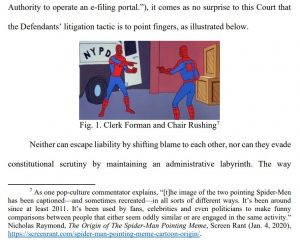
Yeah. You know, in a in a June opinion, earlier this year in 2022, a federal judge incorporated a meme into the opinions narrative to emphasize a rhetorical point. The meme is an image depicting two spider men pointing at each other. I have not seen this before, but it's just, yeah, there's two two spider men there. They're pointing at each other. Apparently, it's a very popular meme that's been used by fans, celebrities, even politicians that are used to reference a circumstance where two opponents are engaging in similar behavior, yet pointing fingers at each other. Maybe it's meant to underscore a funny way to to highlight HIP, HIP criticism if that's a word. I think you
Jeff Lewis 34:13
just I think he just revealed on Saturday mornings you never watched Spider Man and His Amazing Friends or the spider old spider man cartoons or maybe your Yeah.
Tim Kowal 34:21
Yeah, he revealed my lack of of comic book expertise. What one of my favorite memes. Jeff is a lawyer asking Zen master the secret to happiness. The Zen master replies that the secret to happiness is to not argue with fools. And then the lawyer replies, I disagree. And then the Zen master replies, Yes, you are right. I think I could put that in the brief with opposing when opposing counsel makes an especially fatuous argument, Jeff, you could.
Jeff Lewis 34:51
I don't know if you should, but you could maybe bury it in a footnote.
Tim Kowal 34:56
Well, let's see there was one other that maybe we'll We'll we'll pass along to our listeners today. There was I saw this reported that Justice Jackson, our newest Supreme Court Justice speaks at oral argument more than two times more than any other justice. For the October sitting Justice Jackson spoke more than twice as much as any other she had 11,003 words across the eight arguments. Next most was just Justice Sotomayor with 5400 Plus, and Justice Jackson spoke more than six and a half times more than the least active justice who is Justice Thomas. The question is posed by Supreme Court scholar Adam Feldman, who, who passed this statistical analysis along how might oral argument questioning style matter to litigants, he offers four possible reasons that the questioning style might matter. One, it gives less time for other justices to interject giving the questioning justice more time to get his or her points and questions across and less time for opposing justices to get their points and questions across. Another reason oral argument questioning style might matter is that it elicits information that the judge feels is relevant to herself and other justices. A third reason it matters is that it can help shoot down counter arguments and provide reasoning to be used in an opinion. And the fourth factor, it can help the Justice signal his or her position on the issue and gauge other justices positions. Now that this was interesting, it's a it was a jarring statistical analysis about how just how verbose, Justice Jackson is during oral argument.
Jeff Lewis 36:37
Interesting. Yeah, I hadn't come across that. It'll be interesting to see if that relationship is static, or if over time, she speaks shorter or longer during oral argument. Yeah, she
Tim Kowal 36:47
can she keep up that pace, or we'll shoot. Right. All right. Well, let's wrap it up. With that, Jeff, we want to thank our sponsor once more casetext for sponsoring the podcast each week when we include links to the cases that we discussed we use we use casetext for those links and listeners to the podcast can find a 25% lifetime discount available to them if they signed up if they sign up at casetext.com/CALP.
Jeff Lewis 37:14
And if you have suggestions for future episodes, please email us at info at Cal podcast.com. And in our upcoming episodes, look for tips on how to lay the groundwork for an appeal when preparing for trial.
Tim Kowal 37:24
Thanks. We'll see you next time.
Announcer 37:26
You have just listened to the California appellate podcast, a discussion of timely trial tips and the latest cases a news coming from the California Court of Appeal and the California Supreme Court. For more information about the cases discussed in today's episode, our hosts and other episodes, visit the California appellate law podcast website at Cao podcast.com. That's c a l podcast.com. Thanks to Jonathan Cara for our intro music. Thank you for listening and please join us again
Tim Kowal is an appellate specialist certified by the California State Bar Board of Legal Specialization. Tim helps trial attorneys and clients win their cases and avoid error on appeal. He co-hosts the Cal. Appellate Law Podcast at www.CALPodcast.com, and publishes a newsletter of appellate tips for trial attorneys at www.tvalaw.com/articles. Contact Tim at tkowal@tvalaw.com or (714) 641-1232.
Get a weekly digest of these articles delivered to your inbox by subscribing here: https://tvalaw.com/california-appellate-newsletter.
Even more than being buried alive, Justice Lambden says attorneys are terrified of missing an argument. This is why attorneys tend to indulge the temptation to be overinclusive in their arguments.
But making too many arguments comes at the cost of credibility. If the attorney is just “running the loop again,” the bench is more likely to tune out. “We always notice,” Justice Lambden recalled from his time on the Court of Appeal, when an attorney told the court which argument to focus on. You will show courage if you acknowledge a certain argument is not your strongest, and you will earn credibility when you pivot to the argument that is your strongest.
Watch the clip here.
This is a clip from episode 51 of the California Appellate Law Podcast. Listen to the full episode here.
Tim Kowal helps trial attorneys and clients win their cases and avoid error on appeal. He co-hosts the Cal. Appellate Law Podcast at www.CALPodcast.com, and publishes a newsletter of appellate tips for trial attorneys at www.tvalaw.com/articles. His appellate practice covers all of California's appellate districts and throughout the Ninth Circuit, with appellate attorneys in offices in Orange County and Monterey County. Contact Tim at tkowal@tvalaw.com or (714) 641-1232.
When Governor Gavin Newsom selected Justice Patricia Guerrero as the new Chief Justice, he also “appointed” Judge Kelli Evans to fill the empty seat. But there was some debate about whether the governor may “appoint” Evans, or whether instead he needed to “nominate” her, to be confirmed by the voters.
Supreme Court-commentator David Ettinger has written extensively that, under the state constitution, the governor needed to nominate Guerrero’s successor.
Ettinger visits the California Appellate Law Podcast to explain the difference, why it matters — and how his commentary on the issue got him a call from the governor’s office.
Ettinger’s posts explaining the issue are here and here.
The full episode featuring David Ettinger is here.
Watch the clip here.
This is a clip from episode 53 of the California Appellate Law Podcast. Listen to the full episode here.
Tim Kowal helps trial attorneys and clients win their cases and avoid error on appeal. He co-hosts the Cal. Appellate Law Podcast at www.CALPodcast.com, and publishes a newsletter of appellate tips for trial attorneys at www.tvalaw.com/articles. His appellate practice covers all of California's appellate districts and throughout the Ninth Circuit, with appellate attorneys in offices in Orange County and Monterey County. Contact Tim at tkowal@tvalaw.com or (714) 641-1232.
There are several odd things about Trujillo v. City of Los Angeles (D2d1 Oct. 27, 2022 No. B314042) -- Cal.Rptr.3d -- (2022 WL 15119812), a case about accepting a Code of Civil Procedure section 998 offer of compromise. The court held the acceptance was not valid because, even though it was within the statutory 30 days, the acceptance came after the trial court had already granted summary judgment.
The set-up is pretty simple: The City was defending against a claim that it negligently maintained a cracked sidewalk that caused Trujillo to trip during a late-night jog. The City filed a motion for summary judgment. Then just a few days before the hearing, the City served a section 998 offer.
Here is Odd Thing #1: When you get a 998 offer, you have 30 days to accept it. But here, the offer was served only “a few days” before the hearing. (The opinion suggests the offer was made after briefing was complete on February 25, and “a few days” before the hearing on March 2, but gets no more specific than that.) So Trujillo did not have 30 days before the hearing in which to consider the offer.
Back to the case. At the hearing, the trial court orally granted the City’s motion for summary judgment. Four minutes later, Trujillo accepted the 998 offer, and then immediately filed the executed 998 offer.
Note that this is still within 30 days of the offer, which by its terms was to be held open for 30 days (or the commencement of trial).
The trial court rejected the 998 acceptance.
And so did the Court of Appeal. The court held that “a still-pending 998 offer expires when a trial court orally grants summary judgment.” (Italics added.)
The court was very specific about that last language. The court rejected the view that the 998 offer expires earlier than the oral ruling, i.e., at the commencement of the summary-judgment hearing. Or later than the oral ruling, i.e., entry of the written ruling or judgment.
The appellate court reasoned that, under the text of section 998, the offer “may only be made when there exists a dispute to be resolved.” And granting summary judgment resolves all the disputes in the case.
This raises Odd Thing #2: True, the text of section 998 refers to “a dispute to be resolved.” But that is not quite all. The whole sentence from section 998 reads: “Not less than 10 days prior to commencement of trial or arbitration (as provided in Section 1281 or 1295) of a dispute to be resolved by arbitration, any party may serve an offer in writing upon any other party to the action to allow judgment to be taken or an award to be entered in accordance with the terms and conditions stated at that time.” (Italics added.)
So the “dispute” language does not modify the “trial” language. It only modifies the “arbitration” language, which is not relevant to Trujillo.
And then there is Odd Thing #3: What about tentative rulings? Given the court was so explicit that the 998 offer does not expire before the oral ruling, presumably a tentative ruling would not terminate the ability to accept a still-pending 998 offer. This would undermine the purpose of section 998, which the court aims to achieve. That seems an Odd Thing.
Back to the court’s reasoning. The court worries that if a defendant files a 998 offer a few days before a summary-judgment hearing, the plaintiff probably would wait to see what happened at the hearing. And the purpose of the statute is to encourage parties to settle cases.
Odd Thing #4: That may be the purpose of the statute, but the text of the statute gives the plaintiff 30 days to consider an offer. If a momentous event in the case is going to happen before the 30 days is up, it seems an Odd Thing for the court to cut short the statutory 30-days in order to advance the statutory purpose.
One more interesting point about the court’s analysis. One easy way the court could have reached this result—an eminently understandable and common-sense result, by the way—would have been to treat the summary-judgment hearing as a trial. That way, under the text of section 998, the court simply could have found that the 998 offer was not made at least “10 days prior to commencement of trial.” The offer was invalid, and thus the acceptance was invalid, too.
Which leads us to Odd Thing #5: The court explicitly rejected this approach. The court reasoned that summary judgment “is not a substitute for trial” because it does not “entail such a commitment of resources.”
The outcome of Trujillo seems right, but in addition to the Odd Things mentioned above, there are still a few other things about the opinion that seem amiss.
First, it seems unfair to fault Trujillo and her counsel for not accepting the 998 offer in the short space of time after the City served it and the hearing a mere “few days” later. If there was “gamesmanship” afoot, as the court accuses, then one could draw the inference it was committed by the City: A 998 offer served just a few days before the hearing on the MSJ was pretty much guaranteed not to be accepted. And if the City lost its MSJ, the plaintiff—chuffed by her win—was pretty much guaranteed not to accept it then, either.
Recall also that summary judgments are reviewed de novo. The City could consult retired appellate justices to evaluate its ultimate chances of prevailing on the issue of law. So the trial court’s ruling would not really provide significant new information that necessarily would have affected the City’s bargaining position. Yet it would have offered the well-heeled defendant a tactical insight into the plaintiff’s will and ability to stick out her case.
Second, the court’s black-letter holding, pegging the termination of the 998 to the moment of the oral ruling granting MSJ, is inconsistent with the court’s focus on the purpose of the statute. A rigid black-letter rule is not going to achieve the more expansive goal the court has in mind.
Here is why. Consider a related scenario: Plaintiffs often bring claims on contracts that have an attorney-fee provision. Sometimes, such a plaintiff may grow concerned that the defendant may prevail. And if the defendant prevails, the defendant will be entitled to attorney fees. Let’s say that in one of these cases, the defendant files an MSJ. At the hearing, things are not looking so good for the plaintiff. So the plaintiff gets an idea: I’ll ask for a continuance of the hearing. There are some deposition transcripts that only just became available, or whatever, and the court needs to consider that evidence in opposition. Then during the brief reprieve, I’ll dismiss my case without prejudice! Voila: the defendant will not have prevailed on the contract claim, and not be entitled to a fee award!
That is exactly what the plaintiff tried in Mary Morgan, Inc. v. Melzark (1996) 49 Cal.App.4th 765. But the trial court refused to enter the plaintiff’s dismissal. And the Court of Appeal agreed with the trial court.
There are cases with similar scenarios. And “the common thread running through all of these decisions is the notion of fairness, which in turn depends on the plaintiff's motivation and intent in dismissing his complaint.” (Tire Distributors, Inc. v. Cobrae (2005) 132 Cal.App.4th 538, 546.) “The thread of fairness is twisted out of true” in such cases as where a party dismisses after fact-finding has commenced: “To allow real party to dismiss in the wake of an unfavorable referee's [fact-finding] recommendation would work an injustice. Trial had ‘actually commenced’ within the meaning of section 581 and within the policies of fairness in the cases set forth above.” (Gray v. Superior Court (1997) 52 Cal.App.4th 165, 173.)
In my humble opinion, the Trujillo court would have done well to analogize these sorts of cases, rather than fashion a rigid rule that will likely need repair in future cases by amendments and exceptions. Section 998 is plagued by enough strange doctrinal peculiarities as it is.
Tim Kowal is an appellate specialist certified by the California State Bar Board of Legal Specialization. Tim helps trial attorneys and clients win their cases and avoid error on appeal. He co-hosts the Cal. Appellate Law Podcast at www.CALPodcast.com, and publishes a newsletter of appellate tips for trial attorneys at www.tvalaw.com/articles. Contact Tim at tkowal@tvalaw.com or (714) 641-1232.
Get a weekly digest of these articles delivered to your inbox by subscribing here: https://tvalaw.com/california-appellate-newsletter.
If you were a lawyer drawing breath in summer 2022, you heard about the “victory bell” case. A prominent defense attorney, returning to base camp with a stunning victory after defensing a medical malpractice case, rang his firm’s victory bell and announced, the victim “was probably negligently killed, but we kind of made it look like other people did it.” The comment was captured on video, and the internet did its thing.
A common hot-take was that the video would undo the verdict. But many appellate attorneys scoffed: an attorney’s puff talk after trial, the cooler heads responded, is not a trial irregularity.
Enter Brooke Bove, who wrote the successful new-trial motion in Garcia v. Quraishi that got the judgment vacated. Brooke gives an insider look at trial, and why the defense attorneys reference to an empty chair particularly galled the trial judge.
Bove, an Army communications specialist before becoming an appellate attorney, shares her insights into the case and what is coming next, as well as top legal tips and strategies.
Brooke Bove’s biography and LinkedIn profile.
Appellate Specialist Jeff Lewis' biography, LinkedIn profile, and Twitter feed.
Appellate Specialist Tim Kowal's biography, LinkedIn profile, Twitter feed, and YouTube page.
Sign up for Tim Kowal’s Weekly Legal Update, or view his blog of recent cases.
Use this link to get a 25% lifetime discount on Casetext.
Tim Kowal is an appellate specialist certified by the California State Bar Board of Legal Specialization. Tim helps trial attorneys and clients win their cases and avoid error on appeal. He co-hosts the Cal. Appellate Law Podcast at www.CALPodcast.com, and publishes a newsletter of appellate tips for trial attorneys at www.tvalaw.com/articles. Contact Tim at tkowal@tvalaw.com or (714) 641-1232.
Get a weekly digest of these articles delivered to your inbox by subscribing here: https://tvalaw.com/california-appellate-newsletter.
“Are you one of them liberal judges?” someone once asked Justice Lambden. Calling himself a “process judge,” Justice Lambden responded, “Well, if Congress passed a liberal law, I’d enforce it. If it passed a conservative law, then I’d enforce that.” Still, most judges want to get the “right result.”
What does this mean for litigators? Recognizing that most cases really should settle, courts are encouraging more collaborative processes to put cases in a settlement posture. Attorneys should recognize that litigation is an expedition, not a battle.
Watch the clip here.
This is a clip from episode 51 of the California Appellate Law Podcast. Listen to the full episode here.
Tim Kowal helps trial attorneys and clients win their cases and avoid error on appeal. He co-hosts the Cal. Appellate Law Podcast at www.CALPodcast.com, and publishes a newsletter of appellate tips for trial attorneys at www.tvalaw.com/articles. His appellate practice covers all of California's appellate districts and throughout the Ninth Circuit, with appellate attorneys in offices in Orange County and Monterey County. Contact Tim at tkowal@tvalaw.com or (714) 641-1232.